

Who Was Rembrandt?
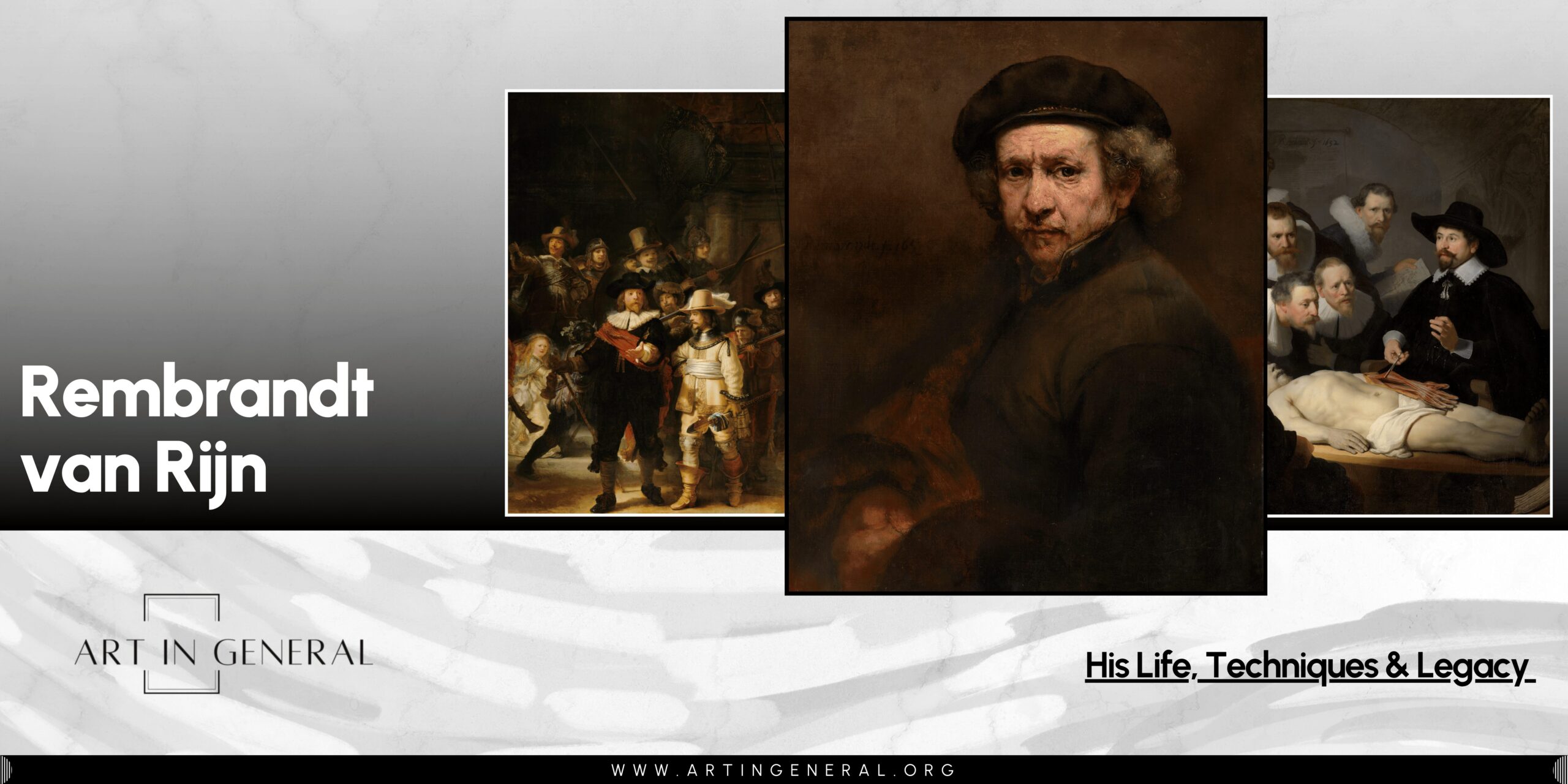
Rembrandt Harmenszoon van Rijn was one of the most remarkable and influential artists of the 17th century. Known for his profound understanding of light, shadow, and human emotion, Rembrandt transformed the possibilities of painting, etching, and portraiture. His works, ranging from intimate self-portraits to monumental historical scenes, demonstrate a mastery of storytelling and a deep empathy for the human condition. Unlike many artists of his time, Rembrandt did not idealize his subjects; instead, he revealed them with honesty, vulnerability, and psychological depth. Through his bold use of chiaroscuro and expressive brushwork, he created paintings that felt alive, illuminated not only by physical light but by the emotions they contain. Today, Rembrandt remains celebrated as one of the most important figures in Western art, a painter whose innovations continue to inspire artists, scholars, and viewers worldwide.
The Dutch Golden Age
Rembrandt lived and worked during the Dutch Golden Age, a period of unprecedented economic prosperity and cultural achievement in the Netherlands. The thriving merchant class fueled a booming art market where portraits, landscapes, and genre scenes were in high demand. Amsterdam, which was Rembrandt’s home for most of his career, was a bustling center of trade, science, and artistic innovation. Unlike the aristocratic patronage systems of Italy or France, Dutch artists relied on private collectors and civic commissions, creating a highly competitive environment that rewarded originality and technical skill.
This cultural landscape shaped Rembrandt’s career from the beginning. The Netherlands’ Protestant identity encouraged intimate biblical scenes and moralizing narratives, forms Rembrandt mastered with extraordinary sensitivity. Meanwhile, global trade brought new pigments, tools, and artistic ideas that expanded artistic possibilities. Rembrandt thrived in this environment, becoming one of the most sought-after portraitists in Amsterdam. His ability to blend realism, drama, and psychological complexity made his work stand out in a society where art was both accessible and deeply valued. Understanding Rembrandt’s world is essential to understanding his genius and to realize that he was both a product of his time and an artist who transcended it.
Early Life & Education
Rembrandt was born on July 15, 1606, in Leiden, the son of a miller and the ninth of ten children. His family valued education, and Rembrandt briefly enrolled at Leiden University before choosing to pursue art full-time, a decision that quickly revealed his remarkable talent. He apprenticed first with Jacob van Swanenburg, who introduced him to history painting and dramatic lighting, and later he learned under the Amsterdam painter Pieter Lastman, known for his narrative compositions and vibrant storytelling.
Under Lastman’s influence, Rembrandt developed a strong foundation in biblical and historical subjects, learning how to convey emotion and drama through composition and gesture. By the age of twenty-two, he had established his own studio in Leiden, where he even began taking pupils despite his young age. His early works already demonstrated a fascination with expressive faces, intricate lighting, and richly detailed surfaces, the traits that would define his mature style later on. Rembrandt’s rapid development, ambition, and confidence set the stage for his meteoric rise when he later moved to Amsterdam, where the flourishing art market opened the door to his greatest successes.
Rembrandt’s Rise in Amsterdam
When Rembrandt moved to Amsterdam in the early 1630s, he entered one of the most vibrant art markets in Europe. The city’s wealth which was generated through global trade, finance, and mercantile power created an unprecedented demand for portraits, historical scenes, and innovative works. It was here that Rembrandt’s exceptional talent blossomed.
He quickly became known for his uncanny ability to capture character and emotion. Unlike many portraitists who flattered their clients, Rembrandt emphasized honesty and psychological presence. His figures appear alive, with glistening eyes, gestures subtle yet full of meaning. Amsterdam’s wealthy regents, merchants, and civic leaders were drawn to this expressive style, and commissions poured in.
During this period, Rembrandt completed The Anatomy Lesson of Dr. Nicolaes Tulp (1632), a masterpiece that propelled him into artistic stardom. His workshop grew rapidly, employing numerous students and assistants, and his home became a bustling studio filled with props, costumes, prints, exotic objects, and students eager to learn from him. By the mid-1630s, Rembrandt was at the height of his success, he as young, brilliant, and widely celebrated.
This era established him not only as Amsterdam’s leading portrait painter but also as an artist capable of elevating everyday subjects to profound emotional narratives. His rise was meteoric, transforming him into one of the most sought-after painters of his generation.
What Did Rembrandt Paint About?
Rembrandt’s art is defined by a deep interest in human emotion, moral complexity, and moments of spiritual or psychological revelation. While he painted many portraits, his subjects extended far beyond capturing physical likeness. Rembrandt painted people as they are: vulnerable, flawed, dignified, hopeful, grieving. His attention to the inner life of his figures makes his work timeless.
He explored:
- Biblical narratives like Samson, Bathsheba, and the Prodigal Son were portrayed with compassion, vulnerability, and human intimacy.
- Historical scenes were painted with psychological tension instead of theatrical spectacle.
- Self-portraits were always honest, raw, spanning youth to old age; a lifelong study of the self.
- Everyday people like beggars, elders, workers, children were always depicted with dignity and empathy.
Rembrandt’s storytelling is unique because he centers emotion rather than grandeur. His paintings feel intimate, as though we witness the internal world of his subjects, not idealizing but revealing what lies beneath the sruface, his ability to convey truth through expression is what makes Rembrandt’s art resonate across centuries.
Rembrandt’s Chiaroscuro
What Makes Rembrandt’s Light Unique?
Rembrandt’s mastery of light is one of the defining features of his art. While he was inspired by Caravaggio and the dramatic tenebrism of the Italian Baroque, Rembrandt transformed chiaroscuro into something profoundly psychological. Rembrandt’s chiaroscuro does more than create dramatic effects, it brings psychological depth to his figures, for example, by using the glow on a cheek, the outline of an aged hand, the shimmer across fabric he created a sense of presence so real that his characters feel alive. This emotional lighting is one of the reasons Rembrandt’s works are incomparable and why he’s regarded as a master of human expression. In his work we can see:
- How light becomes storytelling: Rembrandt used illumination to highlight emotion: a face emerging from darkness, a hand glowing softly, a tear catching a glimmer of light.
- How shadows reveals character: Darkness is never empty, rather than that, it carries weight, mood, and meaning.
- Soft transitions: Instead of the stark contrasts of Caravaggio, Rembrandt preferred gradual, velvety shifts from light to shadow.
- Warm and earthy color palette: Ochres, umbers, lead white, and deep reds create an intimate atmosphere.
- Emotional clarity: His compositions often guide the viewer directly to the heart of the story through light alone.
Rembrandt the Printmaker
Rembrandt is celebrated primarily for his paintings, but his etchings and prints are equally revolutionary and place him among the greatest printmakers in the history of art. He transformed printmaking from a reproductive craft into a powerful medium of original artistic expression. Through his innovative handling of line, depth, drypoint burr, and ink wiping, Rembrandt achieved an unprecedented range of tonal variation, pushing existing techniques far beyond their conventional limits and redefining what prints could convey. His prints also offered greater narrative freedom, allowing him to explore subjects he might not pursue in painting, such as intimate biblical scenes, quiet domestic moments, expressive self-portraits, landscapes, and studies of beggars and everyday figures. Because prints could be produced in multiple impressions, they circulated widely across Europe, making Rembrandt’s work accessible to a broad audience and spreading his reputation long before the age of photography or modern reproduction. Despite their often modest scale, his etchings are marked by remarkable emotional expressivity, capable of capturing complex moods and psychological depth with only a few masterful strokes.
Through printmaking, Rembrandt dramatically expanded the reach and influence of Dutch art, leaving behind a body of work that remains as innovative today as it was in the 17th century. His printmaking legacy is vast, shaping the work of later artists such as Goya, Whistler, and Picasso, and continuing to influence how artists think about line, texture, and emotional storytelling in graphic media.
The Self-Portraits: A Life in Paint
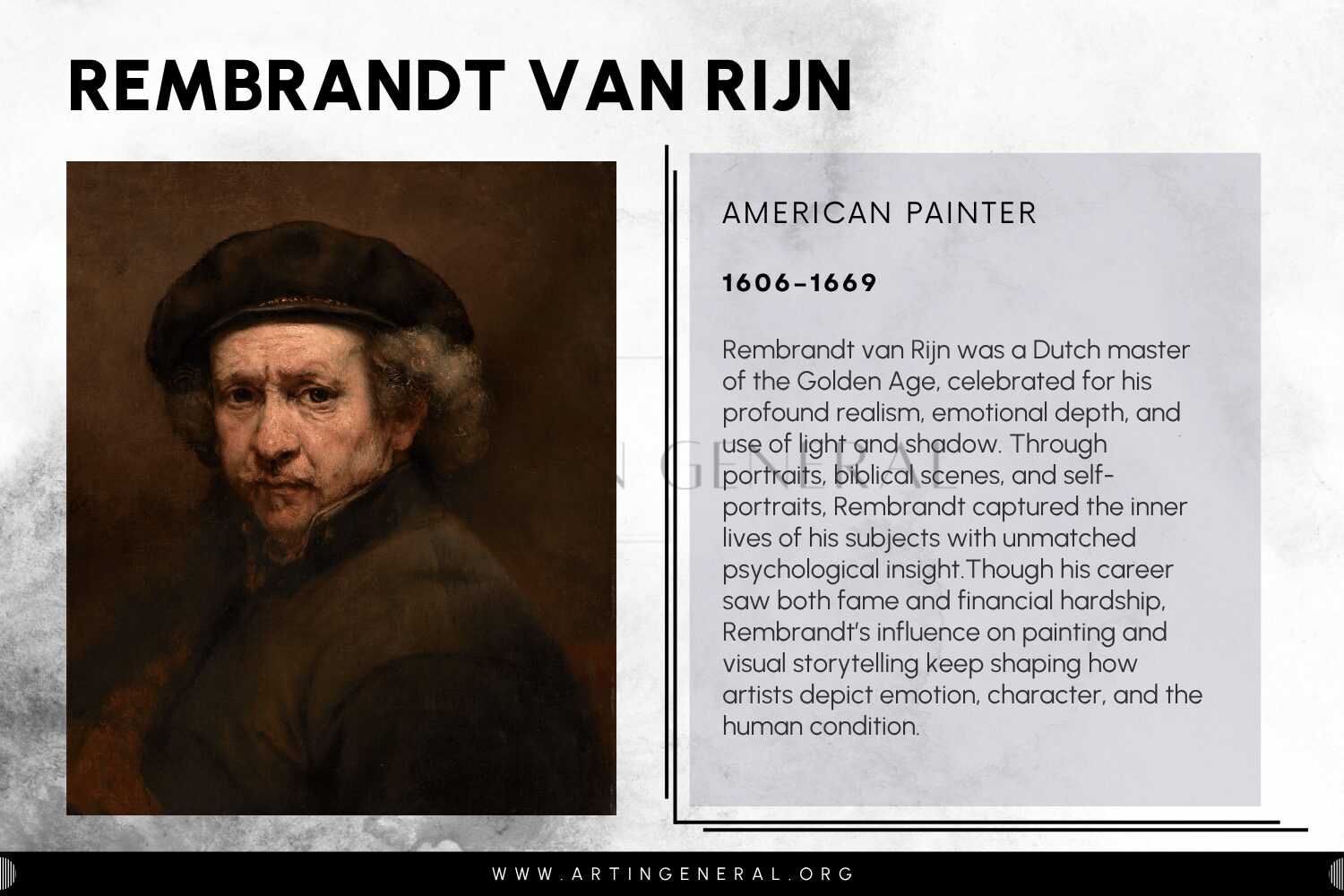
Rembrandt’s self-portraits form one of the most remarkable autobiographical records in the history of art. Across more than forty paintings, etchings, and drawings, he documented himself from confident youth to weary old age, revealing not only physical changes but emotional and psychological evolution.
As a young man, Rembrandt often portrayed himself in dramatic costumes, experimenting with expressions, gestures, and lighting. These early self-portraits were both technical studies and personal declarations of artistic ambition. As he matured, the poses became more introspective. He painted himself not as an idealized figure but as a flawed, vulnerable human being.
His final self-portraits, created in his 50s and early 60s, are among the most moving images in Western art. They show a man who had suffered loss, financial ruin, and diminishing status, and yet they radiate dignity, resilience, and self-awareness. Every wrinkle, shadow, and brushstroke tells a story of survival. Rembrandt’s self-portraits are not mere likenesses; they are confessions, meditations, and acts of profound honesty.
The Night Watch: Innovation, Misunderstanding, Legacy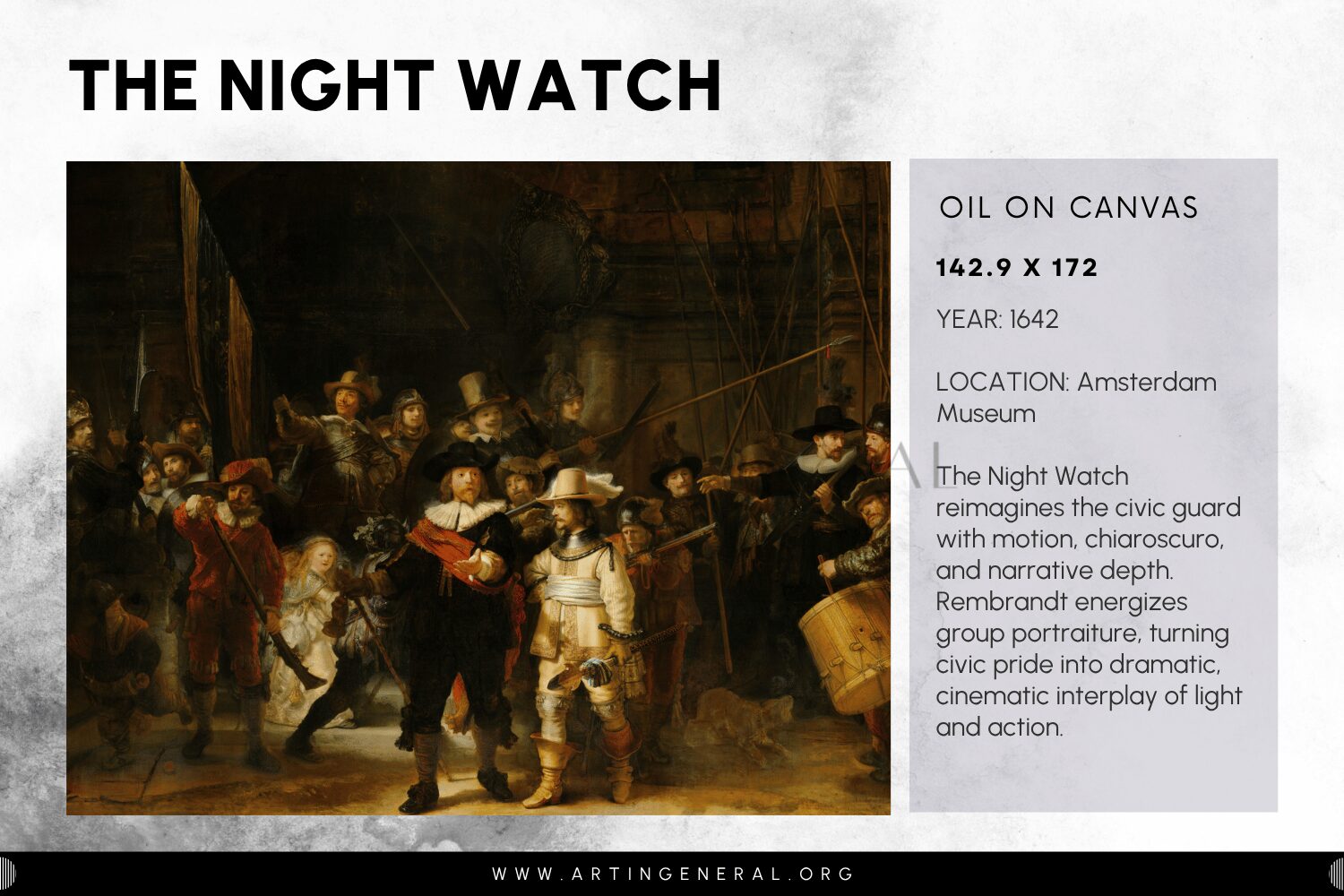
The Night Watch (1642), officially titled The Company of Captain Frans Banning Cocq, is Rembrandt’s most famous and misunderstood painting. Commissioned as a group portrait of an Amsterdam militia company, Rembrandt transformed a traditional format into a dynamic, cinematic scene filled with movement, mystery, and dramatic lighting.
Why It Was Revolutionary
- The figures are in action, not stiffly arranged in rows.
- Light guides the viewer’s eye through a narrative moment.
- The young girl in golden light adds symbolic meaning.
- Depth and diagonals create a sense of chaos and realism.
Why It Was Misunderstood
Many of the militiamen were disappointed that they were not all equally illuminated or centered. In an era when patrons expected clear visibility and status, Rembrandt’s innovative composition felt like a risk, and it cost him future commissions.
The Cropping Tragedy
In the 18th century, the painting was trimmed on all sides to fit a new wall whic altered premanently Rembrandt’s composition. Copies made before cropping show the original width and added figures.
Modern Legacy
Today, The Night Watch is a national treasure of the Netherlands and one of the most analyzed paintings in the world. Its bold storytelling, emotional intensity, and painterly technique secured Rembrandt’s position as a revolutionary innovator.
Key Works and Techniques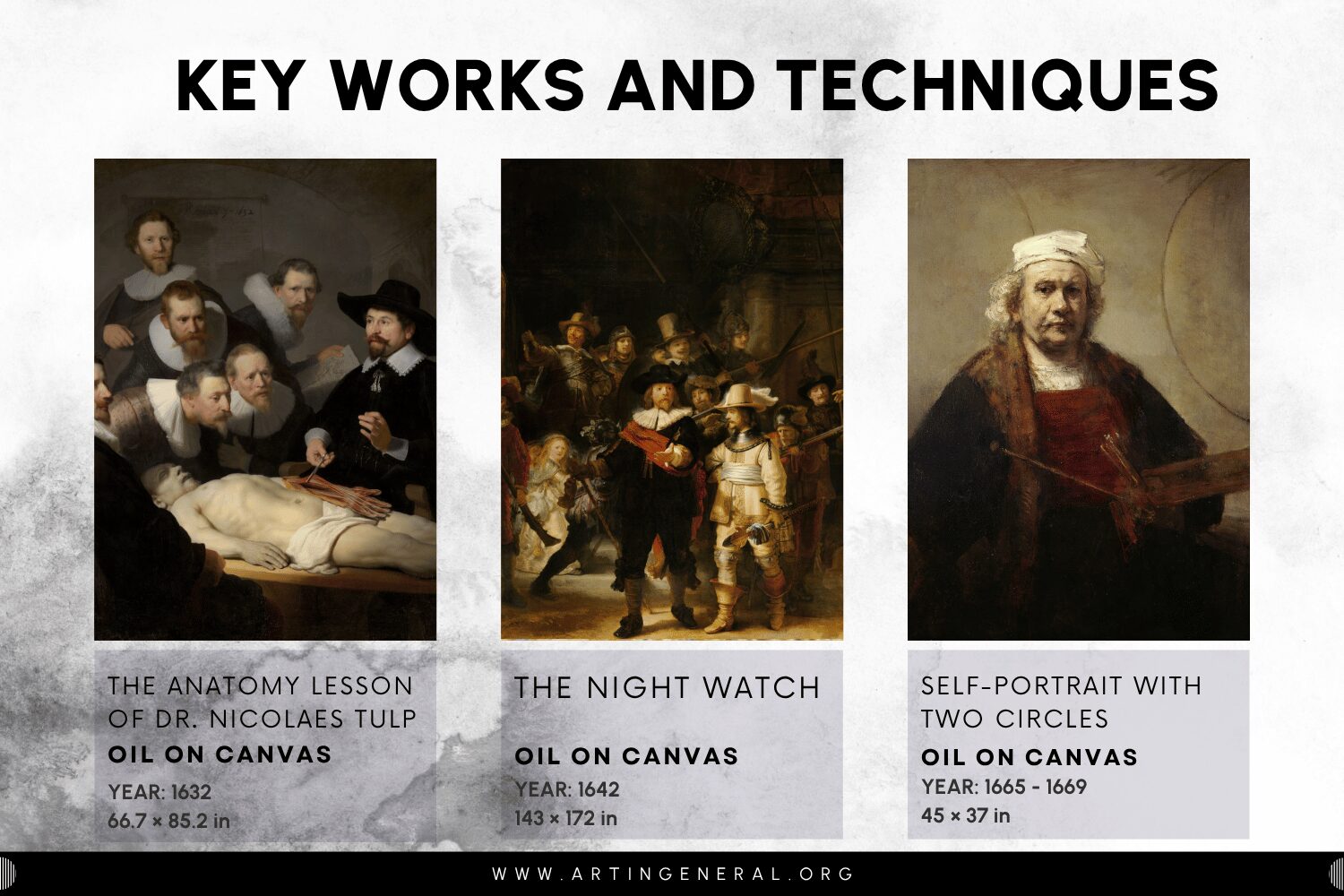
Rembrandt’s masterpieces span portraits, biblical scenes, historical dramas, and intimate narratives. Rembrandt’s technique is defined by a profound sensitivity to both material and emotion. Impasto plays a central role in his later works, where thick, sculptural layers of paint catch and reflect light, giving faces, hands, and fabrics a tangible physical presence. His mastery of chiaroscuro goes beyond dramatic contrast; light and shadow blend in soft transitions that guide the viewer’s attention toward moments of psychological or spiritual importance. This effect is reinforced by his warm palette, dominated by earthy browns, deep reds, glowing ochres, and shimmering whites, which creates an intimate and contemplative atmosphere. Rembrandt’s expressive brushwork remains intentionally visible, allowing the viewer to sense movement, texture, and emotional engagement within each stroke. Above all, his approach is rooted in human-centered storytelling, where emotion takes precedence over idealization and figures are presented with honesty, vulnerability, and profound inner life. His techniques evolved throughout his life, but several characteristics remained central.
Below are detailed analyses of essential works that show the range of Rembrandt’s genius.
The Anatomy Lesson of Dr. Nicolaes Tulp (1632)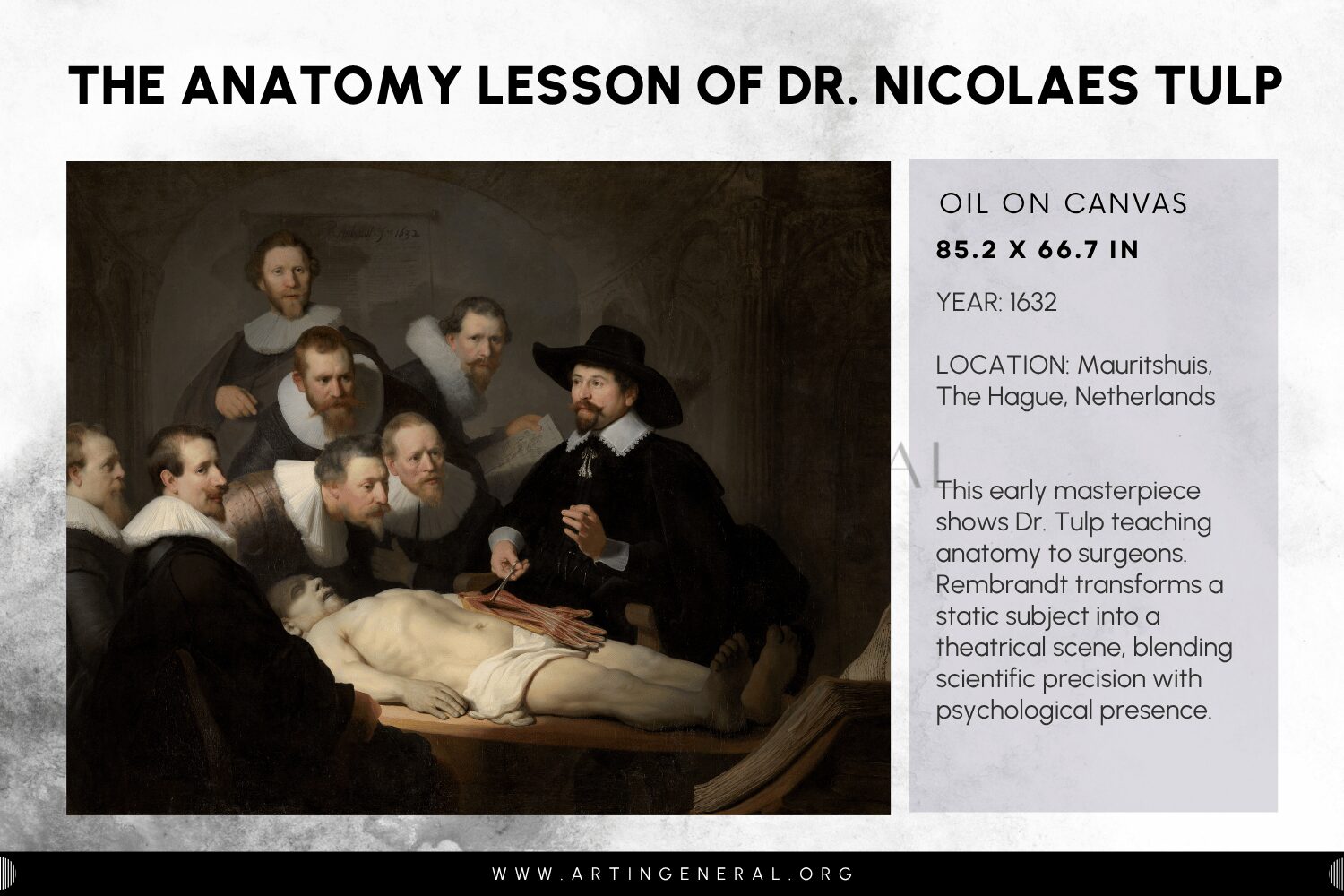
Artist: Rembrandt van Rijn
Medium: Oil on canvas
Location: Mauritshuis, The Hague
Painted shortly after arriving in Amsterdam, The Anatomy Lesson established Rembrandt as a leading portraitist. The scene depicts Dr. Tulp demonstrating the arm muscles of a cadaver to members of the surgeons’ guild. Rather than presenting a static group portrait, Rembrandt arranged the figures dynamically, with each man reacting differently to the lesson. The dramatic lighting focuses attention on the corpse and Tulp’s gesture, turning a scientific demonstration into a theatrical moment. The painting showcases Rembrandt’s early mastery of composition and psychological nuance, merging realism with emotional intensity.
The Night Watch (1642)
Artist: Rembrandt van Rijn
Medium: Oil on canvas
Location: Rijksmuseum, Amsterdam
One of the most celebrated paintings in Western art, The Night Watch captures a militia company assembling for action. Rembrandt’s use of diagonal composition, bold chiaroscuro, and symbolic figures such as the mysterious girl in gold which turn a civic portrait into a vivid narrative. The painting’s dynamism broke centuries of portrait conventions, and its dramatic atmosphere continues to captivate viewers. Despite initial criticism, it is now considered Rembrandt’s masterpiece of storytelling, technique, and innovation.
Self-Portrait with Two Circles (c. 1665–1669)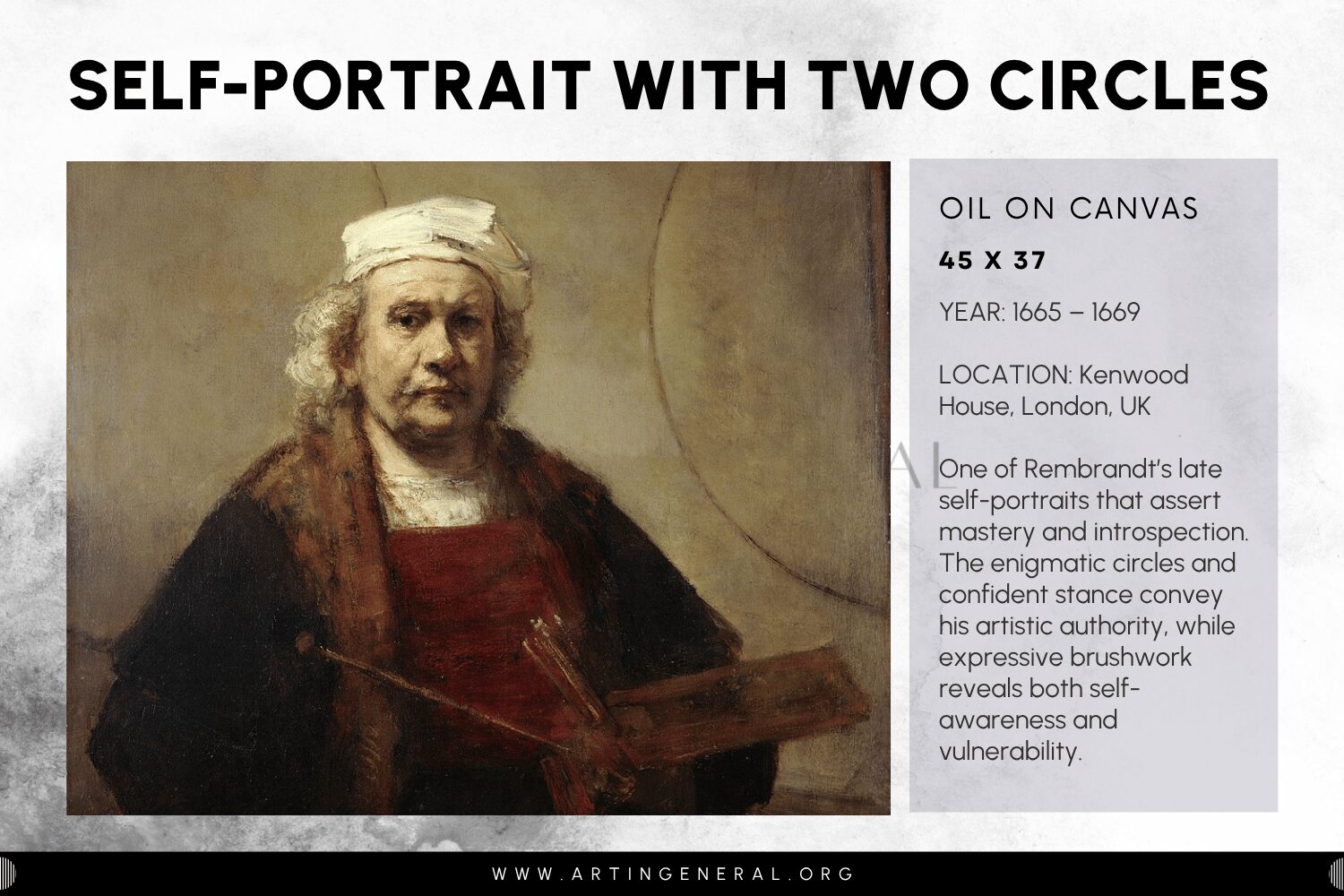
Artist: Rembrandt van Rijn
Medium: Oil on canvas
Location: Kenwood House, London
One of Rembrandt’s most iconic self-portraits, this late work is rich in symbolism and introspection. Rembrandt stands against a neutral backdrop marked by two mysterious circles, possibly referencing artistic mastery or completeness. His gaze is direct and weary. The thick, tactile paint emphasizes texture and age, reflecting the hardships he endured. This is not a vanity portrait; it is a profound statement on identity, mortality, and the role of the artist. Few self-portraits in history match its emotional power.
The Jewish Bride (c. 1667)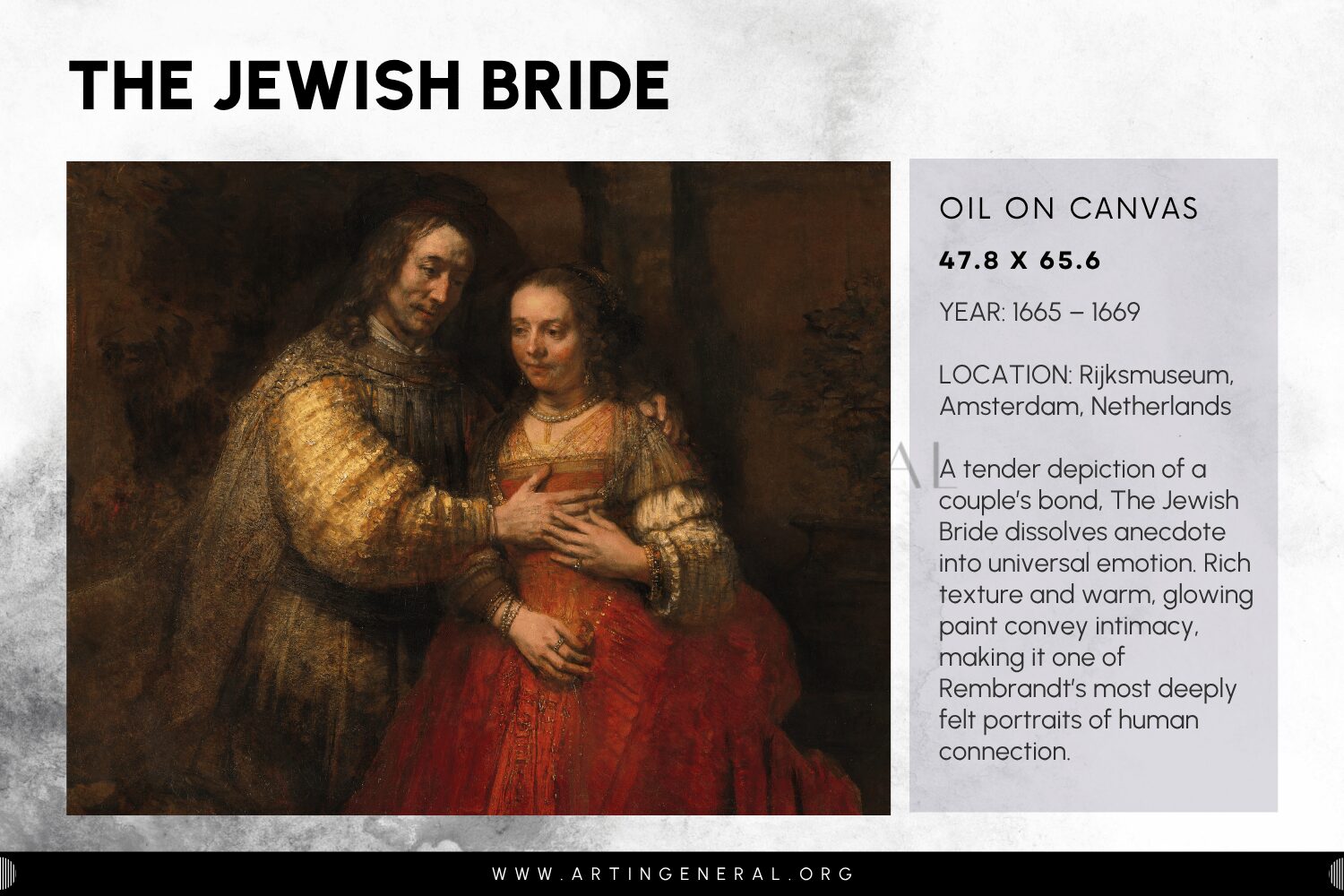
Artist: Rembrandt van Rijn
Medium: Oil on canvas
Location: Rijksmuseum, Amsterdam
This intimate double portrait, long known as The Jewish Bride, depicts a couple bound by affection and tenderness. Rembrandt’s thick layers of paint create a luminous richness, especially in the man’s sleeve, where gold and red tones radiate warmth. The gestures of the couple, the gentle touch on her chest, his protective embrace express profound love. Critics have praised this painting as one of the most moving depictions of human connection ever created.
The Return of the Prodigal Son (c. 1668–1669)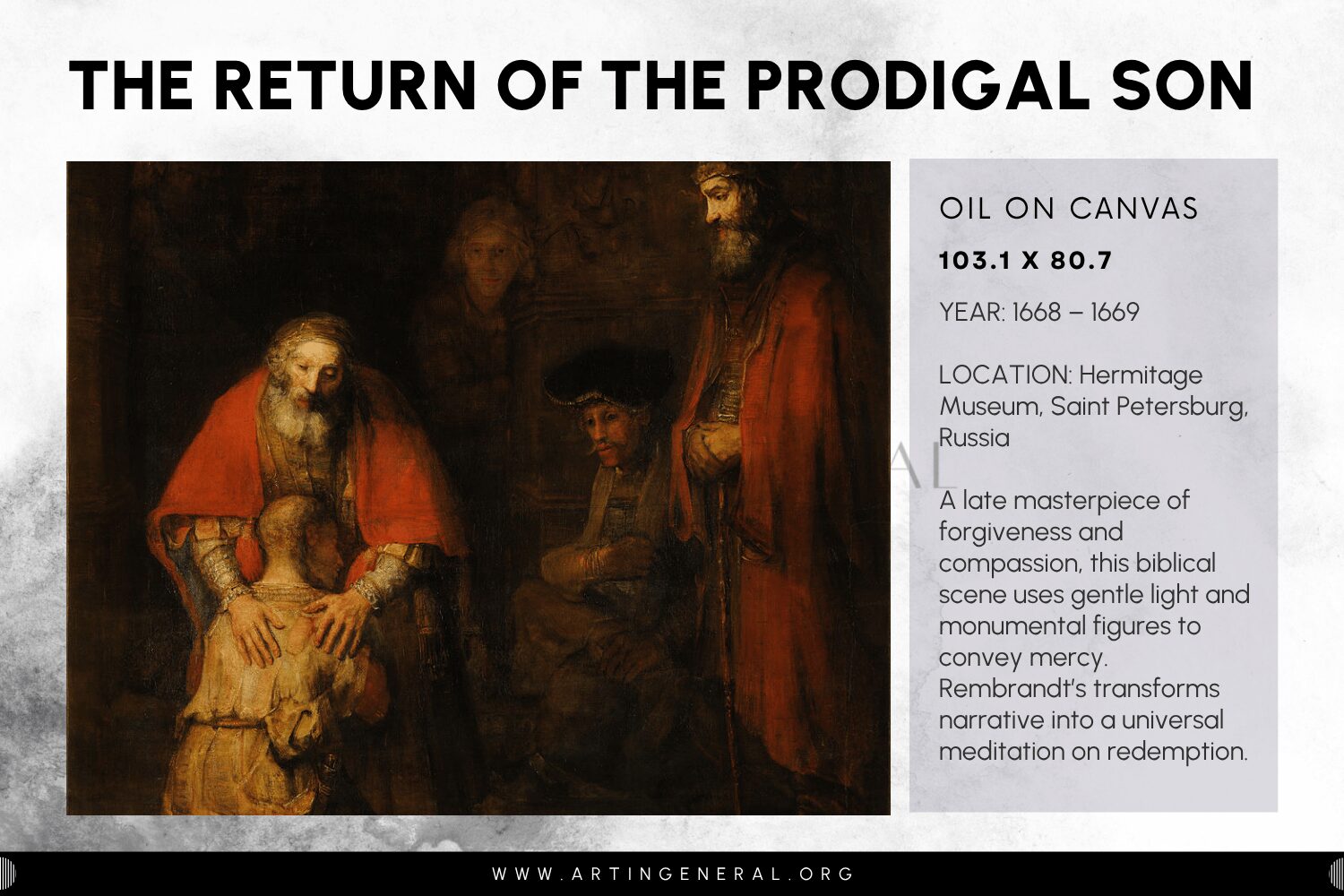
Artist: Rembrandt van Rijn
Medium: Oil on canvas
Location: Hermitage Museum, Saint Petersburg
Often considered Rembrandt’s spiritual masterpiece, The Return of the Prodigal Son captures the climactic moment of forgiveness in the biblical parable. The father’s tender gesture, the kneeling son’s vulnerability, and the soft, enveloping light create a scene overflowing with compassion. Painted near the end of Rembrandt’s life, the work reflects his deep understanding of suffering, mercy, and redemption. Its emotional depth and simplicity make it one of the most powerful paintings in art history.
Rembrandt’s Workshop and Students
Rembrandt maintained one of the most active and influential workshops in 17th-century Amsterdam, training dozens of pupils who would later become accomplished artists in their own right. Aspiring painters paid significant fees to study under him, learning not only composition and gesture but also chiaroscuro, expressive brushwork, and the subtle portrayal of human emotion. The workshop functioned as a dynamic collaborative environment, producing collaborative works in which students blocked in compositions that Rembrandt would later refine, as well as imitations painted in his style for the open art market. Alongside these practices, the studio encouraged experimentation and fostered a highly sought-after form of artistic training that shaped the course of Dutch painting for decades.
This prolific output, however, created lasting attribution challenges that persisted long after Rembrandt’s death. Many paintings associated with his name were the result of studio collaboration, student work, or later imitation. In the 20th century, the Rembrandt Research Project undertook a systematic re-examination of hundreds of paintings, using technical analysis, historical documentation, and stylistic study to distinguish between works by Rembrandt himself, those by his pupils, and those by later followers. This rigorous scholarly effort fundamentally reshaped how museums, historians, and collectors understand Rembrandt’s body of work, refining his catalog and deepening appreciation for both his genius and the complex artistic ecosystem surrounding him.
Rembrandt’s Personal Challenges
Despite early fame, Rembrandt faced immense hardships later in life. His beloved wife Saskia died young, followed by the loss of three of their four children. Financial mismanagement and decreased commissions eventually forced Rembrandt into bankruptcy. He sold his home, possessions, and studio, relying on the support of Hendrickje Stoffels (partner) and his son Titus.
Yet throughout these tragedies, Rembrandt continued to paint with increasing depth and emotional honesty. His late works, marked by thick impasto and warm, glowing light, are among the most moving renderings of humanity ever produced. They bear the marks of suffering but also of profound insight and resilience. His personal challenges did not diminish him, they transformed his art into something timeless.
The Late Style: Rough Beauty and Spiritual Depth
Rembrandt’s late works are among the most extraordinary achievements in Western art. After years of personal loss, financial ruin, and emotional hardship, his style evolved into something raw, introspective, and profoundly human. The polished surfaces and refined detail of his early career gradually gave way to thick impasto, where paint was applied in heavy, sculptural layers that catch and reflect light, giving his figures a physical, almost tangible presence. This transformation was accompanied by warmer, earthier tones, which envelop his compositions in an atmosphere of intimacy, silence, and contemplation. His looser, expressive brushwork increasingly prioritized emotional truth over precision, allowing feeling to guide form rather than the other way around. At the same time, Rembrandt embraced simplified, powerful compositions, stripping away unnecessary detail to focus the viewer’s attention on the emotional core of the scene. These technical and stylistic shifts supported deeply moving themes of forgiveness, suffering, resilience, and redemption, which dominate his final works.
Paintings such as The Jewish Bride and The Return of the Prodigal Son embody this late style with unmatched tenderness and spiritual gravity. They are not demonstrations of technical virtuosity alone, but emotional revelations shaped by lived experience. In these final works, Rembrandt appears to paint not merely what he observed, but what he had come to understand: the fragile balance between human vulnerability and enduring strength.
Legacy & Influence
Rembrandt’s impact on the history of art is immense. His approach to light, emotion, and storytelling changed the trajectory of painting, influencing artists across continents and centuries. His innovations in portraiture and narrative scenes transformed how artists approached humanity, sincerity, and psychological depth.
Rembrandt’s influence can be seen in:
- Goya, who echoed Rembrandt’s emotional honesty and dramatic contrasts.
- Van Gogh, who admired his thick paint and expressive portraits.
- Monet and the Impressionists, who studied his light and impasto.
- 20th-century Expressionists, inspired by his treatment of emotion.
- Modern photographers and filmmakers, who borrow his chiaroscuro techniques.
His prints circulated globally in his lifetime, shaping artistic practice far beyond the Netherlands. Today, Rembrandt remains a cornerstone of museum collections, academic study, and artistic training. His works continue to speak to new generations because they capture something universal: the complexity, vulnerability, and beauty of being human.
Conclusion
Rembrandt van Rijn remains one of the most powerful and influential artists in history, not because he painted ideal beauty, but because he painted truth. His portraits breathe with humanity; his biblical scenes radiate compassion and drama; his landscapes and etchings reveal a deep sensitivity to the world around him. Through triumph and tragedy, Rembrandt never stopped experimenting or evolving. His art bears the mark of a man who looked at life and translated it into light, shadow, and texture.
His legacy endures because his paintings are not just masterpieces of technique; they are acts of empathy, storytelling, and emotional honesty. Rembrandt shows us that art has the power to illuminate the human soul. Through his work, we are reminded that beauty can be found not in perfection, but in sincerity.
FAQ
Q: What is Rembrandt best known for?
A: Rembrandt is best known for his masterful use of light and shadow, his emotionally rich portraits, and iconic works such as The Night Watch, The Anatomy Lesson of Dr. Nicolaes Tulp, and The Return of the Prodigal Son.
Q: Why is Rembrandt considered one of the greatest painters?
A: His unparalleled ability to capture human emotion, combined with groundbreaking technical techniques and storytelling, makes him one of the most influential artists of all time.
Q: What painting technique did Rembrandt use?
A: Rembrandt used chiaroscuro, expressive brushwork, and impasto to create depth, atmosphere, and emotional intensity. His late style features especially thick, textured paint.
Q: Where can I see Rembrandt’s artworks?
A: Major collections are held at the Rijksmuseum (Amsterdam), the Hermitage Museum (St. Petersburg), the Mauritshuis (The Hague), the National Gallery (London), and numerous museums in the U.S. and Europe.
Q: Did Rembrandt paint a lot of self-portraits?
A: Yes. His self-portraits are considered one of the greatest visual autobiographies ever created.
Further Reading & References
Books & Academic References
- Alpers, Svetlana. Rembrandt’s Enterprise: The Studio and the Market. University of Chicago Press, 1988.
- Clark, Kenneth. Rembrandt and the Italian Renaissance. Pelican Books, 1966.
- Schwartz, Gary. Rembrandt: His Life, His Paintings. Viking Press, 1985.
- Tümpel, Christian. Rembrandt: Images and Metaphors. Haus Publishing, 2006.
- Slive, Seymour. Rembrandt and His Critics. Harvard University Press, 1953.
- Chapman, H. Perry. Rembrandt’s Self-Portraits: A Study in Seventeenth-Century Identity. Princeton University Press, 1990.
- Schama, Simon. Rembrandt’s Eyes. Viking Press, 1999. (Gorgeous, narrative-heavy, widely respected)
- Garrard, Mary. Rembrandt and the Female Subject. University of California Press, 2020.
- van de Wetering, Ernst et al. A Corpus of Rembrandt Paintings. Volumes I–VI, Springer, 1982–2014. (Gold standard reference on attribution)
Leave a Reply